
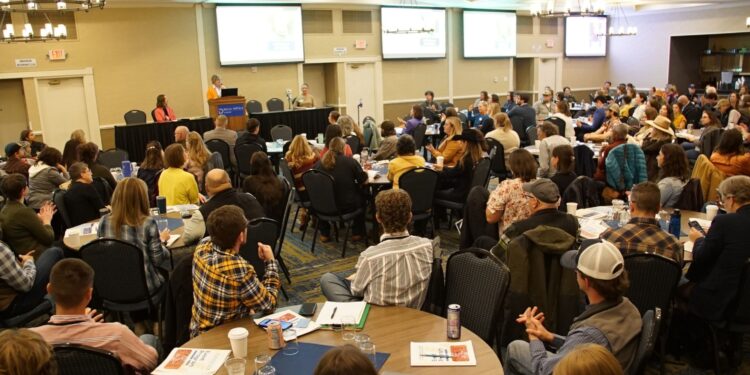
Governor's Summit Overview
The third Governor’s Summit on Montana Food and Agriculture, Maximizing Montana’s Agriculture Opportunity, convened producers, processors, distributors, institutional buyers, agencies, and nonprofits on October 23–24, 2026, at the Marriott Helena Colonial Hotel in Helena. It was hosted by the Grow Montana Food Policy Coalition in partnership with the Montana Department of Agriculture and the Governor’s Office (MDA).
Held roughly once a decade, the summit is only the third of its kind in thirty years. Its purpose this year was to produce a strategic roadmap for the 33×33 for Montana Initiative: raising the share of Montana-produced food on Montana plates from about 3% to 33% by 2033 (Abundant Montana). Abundant Montana reports helping coordinate more than 31 partners, including the Governor’s Office, to produce the event. Holly Stoltz of Western Sustainability Exchange (WSE) served on the summit planning committee.
The two previous summits (2007 and 2016) produced durable results: legislative reforms that simplified public purchasing of Montana-grown food, creation of the Food & Agriculture Development Centers (FADCs), updated food safety rules allowing direct-to-consumer sales of non-hazardous foods, and expanded Farm to School and MSU Extension local food programming (Grow Montana).
Why It Matters
Montanans spent $5.2 billion on food in 2021, but only $158 million of it, about 3%, went to food produced in the state. In 1950, roughly 70% of what Montanans ate was grown or raised here (Abundant Montana).
- Spent on Montana-produced food - $158 million (about 3%)
- Additional economic activity per $1 of local food spending - $0.47
- Share of the food dollar farmers can retain through local channels (USDA) - Up to 4–5 times more
- Annual spending on Montana school meals - $76.6 million
- Added local sales if one-third of school meal spending were Montana-sourced - Over $25 million per year
- Food spending the initiative aims to retain in-state - $1.5 billion per year
Sources: Grow Montana; Montana Department of Agriculture.
Organizers also stressed resilience. During COVID-19, CSAs and food hubs kept food moving when national distribution faltered, and shorter supply chains diversify farm income while complementing Montana’s export markets.

How the Summit Worked
The agenda was built from a year of pre-summit work: a statewide stakeholder survey and regional listening sessions held in communities including Billings, Bozeman, Glendive, Great Falls, and Lewistown (Grow Montana). Those sessions identified distribution, processing capacity, and high land costs as the leading statewide barriers, followed by funding, labor, regulation, grocery access, competition from national distributors, meat inspection, aggregation, and school budgets (Abundant Montana pre-summit presentation).
The two days combined keynotes, panels, Montana-grown meals, and facilitated work sessions organized around four themes:
- Healthy Soil — regenerative and climate-healthy agriculture for long-term productivity and stewardship
- Healthy Food & People — access to Montana-grown whole foods and their role in public health
- Resilient Markets & Economy — local and regional markets that create jobs and raise farm income
- Strong Communities — place-based infrastructure and rural economic strength
In the work sessions, participants first divided by product category (produce, grains, and proteins) and then by market segment: institutional, wholesale/retail, and direct-to-consumer. Each group worked through the levers that could move the needle in its segment, including legislation and policy, programming, infrastructure, and financing, and then committed to specific actions with named conveners.
What We Heard
The consistent message was that Montana already has most of the pieces of a strong local food system; the work ahead is connecting them.
- Montana Department of Agriculture Director Jillien Streit named the core challenges as connecting producers with consumers, keeping more Montana products in use in-state, and building the infrastructure and logistics to move local food to Montana consumers. She urged participants to stay connected and aim high, and tied the goal to soil health and multigenerational farm continuity
- Robin Kelson, Executive Director of Abundant Montana, argued that the 3% figure reflects missing connective infrastructure rather than a lack of product. She pointed to Montana’s clean beef and high-protein grains and oilseeds, most of which are exported, and said the state’s task is to link the regional efforts already underway.
- Grace Nichols, FADC Director at the Ravalli County Economic Development Authority, credited the earlier summits with expanded in-state distribution, meat processing investment, Farm to School growth, and the FADC network itself.
- Producers, including Kari Groeneweg of Living Sky Grains in Three Forks, emphasized the value of family-farm products reaching Montana tables.
Sessions for producers covered building local supply chains, financing production, and reaching rural food markets (MTPR).

Outcomes
Participants left Helena with roughly twenty concrete ideas, now being carried forward by volunteer action teams over the coming year.
For institutional markets, the ideas center on making local purchasing the norm: state incentives, and possibly a required local percentage, for schools, hospitals, and other institutions; state funding to offset the cost of buying local; statewide promotion of Montana Mondays; and K-12 curriculum that connects food, agriculture, and nutrition. Participants also proposed replicating a proven food processing facility model in Central Montana, expanding farmland access through long-term leases, conservation easements, and farmland banks, creating insurance and emergency relief for specialty crop loss, and building a new statewide investment strategy for the food system.
For retail and wholesale, the ideas focus on connecting the value chain: convening grain buyers and sellers, bringing protein producers together with retailers, expanding workforce training for meat processing, building a digital tool that links producers with distributors, restaurants, and stores, forming a local food policy working group, and launching a statewide 33×33 campaign to shift consumer buying habits.
For direct-to-consumer sales, the ideas aim to lower barriers for smaller producers: documenting and addressing regulatory obstacles, building a statewide distribution network that begins with produce and specialty growers, developing community-supported financing and land access for small and tribal producers, creating a model for farm hubs and farm stops, and consolidating Montana food system resources into a single online library.
Priority gaps and policy ideas
Two needs surfaced across nearly every breakout. The first is a shared statewide map of who is doing what. Many organizations are working on overlapping pieces of the food system without visibility into one another’s projects. Participants called for a single, regularly updated place where groups can post their current work, partners, and needs, so the network can see what is already underway, where the gaps are, and where to lend support. The Spred-led resource library and the Basal-led communication app are early efforts in this direction, building on Abundant Montana’s existing Find Food and Farms and Farm to Wholesale maps.
The second need was policy change to put more Montana food on Montana plates. Ideas raised at the summit and in the action-planning sheet include:
- Medicaid coverage or riders for food prescriptions (“food is medicine”), linking health care spending to Montana-grown food
- State incentives, and possibly a required minimum percentage, for local food purchasing by schools, hospitals, and other institutions
- Montana-friendly institutional RFP language and state purchasing commitments, a solution identified in the pre-summit listening sessions
- Regulatory reform affecting local food sales, including sanitarian requirements and inspection rules
- Insurance products and emergency funds to protect specialty crop producers from crop loss
- New statewide investment vehicles and community-supported financing for producers and land access
Infrastructure gaps also remained central: aggregation and distribution to rural grocery stores and institutions, meat processing capacity and its workforce, and farmland affordability for new and small producers.
WSE Involvement and Next Steps
Several action teams align closely with WSE’s supply chain programs:
- Montana protein in retail and workforce training for meat processing align with Ranch of the Month, the Grocery Store Connection, and the Markets Broker effort to connect regenerative ranchers with buyers.
- Medicaid food prescriptions and institutional purchasing policy align with WSE’s developing Food is Medicine program.
- The shared statewide map of initiatives would give the Expanding Markets Conference and WSE’s partner network a way to post its work and find collaborators.
The WSE team is still considering what action teams to formally join beyond the accountability group. We will keep you posted on any updates.


